
Stranger Than Fiction
December 2025
Behind Enemy Lines
by Dean Jobb
From the Civil War to World War Two, new nonfiction books recount the thrilling—and largely forgotten—exploits of formidable women who outwitted the enemy, protected art treasures from the Nazis, and helped British soldiers escape from occupied Europe.
Soon after the fall of France in 1940, two women living in Paris—one an American widow, the other a British divorcée—were stopped at German checkpoints as they returned to the city in their sleek Peugeot. None of the soldiers who let Etta Shiber and Kate Bonnefous pass suspected they could be a security threat. They were “two middle-aged respectable women of sheltered background,” as Shiber later described her friend and herself. And that’s what made them so successful at the risky business of smuggling stranded Allied soldiers to freedom.
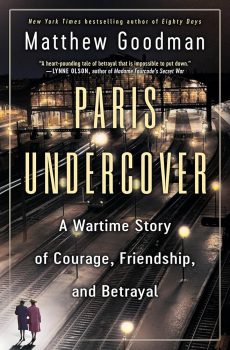 Acclaimed author Matthew Goodman tells the incredible story of this unlikely duo’s dangerous work for the French resistance in Paris Undercover: A Wartime Story of Courage, Friendship, and Betrayal (Ballantine Books). “Their natural appearance—the lined faces, the eyeglasses, the gray in the hair—concealed them more effectively than any wigs or false noses,” he writes, “providing almost a cloak of invisibility.” They hid in plain sight as they hoodwinked the Nazis and plotted how to rescue prisoners of war.
Shiber, sixty-two in 1940, and Bonnefous, who was nine years younger, had met in 1926 when Shiber, a New Yorker on holiday, was shopping at Bonnefous’s Paris clothing store. “A deep sympathy developed between us immediately,” Shiber explained, and they became close despite the ocean between them. In 1937, after Shiber’s husband died, Bonnefous—now divorced from her French husband and alone in a large Paris apartment—invited her friend to come live with her. Shiber accepted, despite the looming threat of a second world war.
Bonnefous instigated and led their two-person unit that rescued British soldiers stranded after the evacuation of Dunkirk. She had skills the role demanded—she was confident, spoke several languages, had owned her shop at a time when few women in France ran their own businesses—and also the motivation. Her son was serving in the French navy and, before the war, she had delivered care packages to French soldiers. Shiber was a reluctant but able accomplice. The stakes were high: topping the list of offenses the Nazis threatened would be “punished most severely” was “assistance provided to non-German military located in the occupied territories.”
A luggage compartment, hidden behind the back seat of the Peugeot, was used to whisk escapees from military prisons and hospitals. Nazi officials were bribed—usually with gifts of hard-to-find chocolate—to provide extra rations of gasoline for the trips. On one mission, two German officers flagged down the car and asked for a ride, unaware that a British soldier was crammed into the space behind their seat. Escapees laid low in the Paris apartment as the pair arranged for forged identity papers and developed the network of helpers needed to ferry them south, to unoccupied Vichy France, and back to Britain. They aided at least twenty soldiers before they were caught by the Gestapo and imprisoned. Shiber was released and returned to the U.S. in 1942 but Bonnefous, originally sentenced to death for her leadership role in the escape ring, spent the remainder of the war in a prison in Germany.
Shiber revealed their exploits in a memoir, Paris-Underground, published in 1943. It became a bestseller at a time when Americans were hungry for stories of triumphs over fascism and spawned a radio drama and a movie. Goodman, author of Eighty Days: Nellie Bly and Elizabeth Bisland’s History-Making Race Around the World, reveals there was much more to this story of two women standing up to the evils of Nazi Germany. His deep research and insights strip away layers of embellishment and contradiction to expose this true story of wartime heroism and personal tragedy.
Shiber and Bonnefous were trapped behind enemy lines. Elizabeth Van Lew was born there. She was a member of a wealthy and prominent family in Richmond, Virginia, which became the capital of the Confederate States at the outset of the Civil War. She recalled with bitterness the day in 1861 when the Confederate flag—the “flag of treason,” she called it—was hoisted over the state building. “I never did remember a feeling of more calm determination and high resolve for endurance over me than in that moment,” she wrote. Her determination was to do anything she could to support the Union cause.
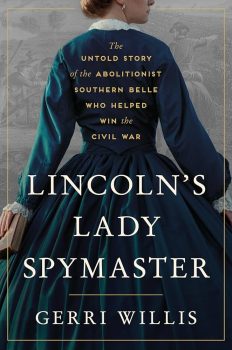 Award-winning television reporter and anchor Gerri Willis tells Van Lew’s inspiring story in Lincoln’s Lady Spymaster: The Untold Story of the Abolitionist Southern Belle Who Helped Win the Civil War (Harper). Van Lew’s family lived in one of Richmond’s finest mansions and was well connected. She could command audiences with top Rebel politicians and military officials and, legend has it, even the wife of Jefferson Davis, the president of the Confederacy.
Van Lew was a Southern belle but her roots and mindset made her a Northerner. Her father, originally from Long Island, had run a prosperous hardware business in Richmond. She was educated in Philadelphia and became sympathetic to the abolitionist cause, even though her father owned slaves. When he died in 1843, Van Lew and her mother began paying wages and offering freedom to their enslaved household staff. They scandalized Richmond society by having the child of one of their Black servants baptised in their upscale neighborhood’s church.
When war broke out, Van Lew used her contacts to gain admission to camps set up in the city to house Union prisoners. Prison conditions were deplorable—poor rations, disease, cruel guards—and she brought gifts of food, bandages, and books to relieve some of the misery. She went from gathering information about Rebel troop deployments overheard by prisoners to helping some inmates to escape, and before long she was overseeing a network of spies, agents, and safe houses that one historian called “the most productive espionage operation of the Civil War, on either side.” Her biggest coups were furnishing Union commander Ulysses S. Grant with crucial information about the South’s weakened defences as the general mounted the final offenses of the war.
She took enormous risks. Northern sympathizers were jailed without charge and a law was passed authorizing the seizure of the property of anyone deemed an enemy of the Confederacy. Spies faced imprisonment or execution. Timothy Webster, a Pinkerton detective who posed as an arms dealer to gain access to weapons depots and military camps, was exposed as a Union spy and hanged. Van Lew’s Union sympathies and aid to prisoners of war were widely known and made her a target. In one unnerving incident, a stranger followed her along Richmond’s streets and pulled close enough to whisper a threat in her ear. “We have to be watchful and circumspect—wise as serpents—and harmless as doves,” she noted in her diary in June 1862, “for truly the lions are seeking to devour us.”
Willis’s breezy, well-paced narrative sifts through a century and a half of myth, conjecture, and conflicting information in an effort to present “the real and true story of Elizabeth Van Lew.” And there’s no more tantalizing story connected to this Yankee spy in the heart of the Confederacy than the claim that she embedded one of her Black servants, Mary Jane Richards, in the “Southern White House”—the home of Jefferson Davis. Richards was a remarkable woman in her own right. The Van Lews paid for her education at a northern school and sent her to Liberia for five years, to work with resettled former slaves. By some accounts, she stole secrets under the Rebel president’s nose for years; after the war, Richards claimed to have made only a single foray into the home, on the pretext of collecting laundry, to search for documents. Which version is true? In this, as in other disputed aspects of Van Lew’s contribution to the Union war effort, Willis presents the best evidence and leaves it to the reader to decide.
While Shiber and Bonnefous were doing their part to resist the German occupation of France, another Parisian was thwarting Nazi efforts to loot masterpieces from the city’s galleries and museums. Curator and art expert Rose Valland risked her life to spy on the Germans and to protect treasures housed in her Jeu de Paume museum, the Louvre, and other French galleries and institutions as Hitler’s henchmen assembled works to fill the dictator’s planned Führermuseum.
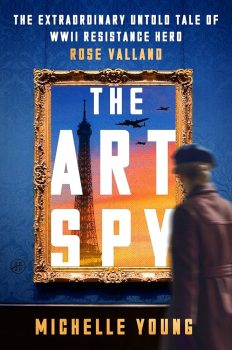 Award-winning journalist, author, and academic Michelle Young dug deep into the historical record to unearth the long-lost details of Valland’s heroics in The Art Spy: The Extraordinary Untold Tale of WWII Resistance Hero Rose Valland (HarperOne). Quiet and unassuming, she passed herself off as a minor civil servant left with the keys to the museum when France capitulated in 1940. “She had learned to play the role of a nobody . . . not important enough to notice, not congenial enough to be flirted with, and too grave to be easily friends with,” Young explains. In truth, “she was one of the most well-educated art historians” in the country. This combination of knowledge and low profile made her the perfect secret weapon to foil the Nazi’s plans to plunder her nation’s artistic and cultural heritage.
Valland was an unlikely candidate to become a spy and an operative for the French resistance. Her art studies allowed her to escape a childhood in rural France and her struggle to win a post as a curator—an uphill battle against the sexism rife in the man’s world of French art and museums—steeled her for the more formidable and dangerous foes she faced in wartime. When the Nazis transformed the Jeu de Paume as a clearinghouse for stolen paintings and sculptures being shipped to Germany, she was in the right place at the right time to expose and undermine their efforts.
Young traces Hitler’s obsession with art—and bitterness over his own spurned efforts as a young artist—as she recreates the international art scene and its painters, sculptors, brokers and collectors as the world plunged into a second global war. She tells the parallel story of Jewish art dealer Paul Rosenberg, who was forced to leave behind a priceless art collection when he fled France in 1940, and his son Alexandre, who joined General Charles de Gaulle’s Free French army and fought his way back to Paris after D-Day. Along the way Young weaves in the wartime experiences of famed artists such as Pablo Picasso, who hid valuable artwork under the noses of Paris’s occupiers, and efforts to keep the Mona Lisa and other iconic works out of the clutches of the voracious Nazis.
Did the Germans discover Valland’s espionage and deception? Was she able to save some of the world’s most treasured artwork from theft and destruction? And did Alexandre Rosenberg survive the war and avenge the Nazi plunder of his family’s fortune and the horrors of the Holocaust? Read this fast-paced page-turner to find out.
———
Dean Jobb’s latest true crime book, A Gentleman and a Thief: The Daring Jewel Heists of a Jazz Age Rogue(Algonquin Books and HarperCollins Canada), is a New York Times Editors’ Choice and a national bestseller in Canada. It’s the story of Arthur Barry, who charmed the elite of 1920s New York City while planning and executing some of the most brazen jewel thefts in history. Find him at deanjobb.com.
Copyright © 2025 Dean Jobb