
Stranger Than Fiction
June 2025
Celebrated Cases
by Dean Jobb
From the infamous Scopes Monkey Trial and the murder case that inspired the hit musical Chicago to the sex scandal that led to movie legend Charlie Chaplin’s banishment from the U.S., a roundup of recent books that explore some of the twentieth century’s most sensational courtroom battles.
It was a clash of faith and science, a war between religious fundamentalism and modernism that tested the limits of freedom and democracy. This battle for hearts and minds turned on a single, divisive question: did a government or faction have the right to control the subjects that could be taught to children in public schools? A century before campaigns to ban books celebrating diversity and inclusion from America’s school libraries, a courtroom in the small Tennessee town of Dayton was the scene of a sensational trial over the teaching of Charles Darwin’s theory of evolution. H.L. Mencken, the cantankerous social critic of the 1920s, dubbed it the “monkey trial,” and the name stuck.
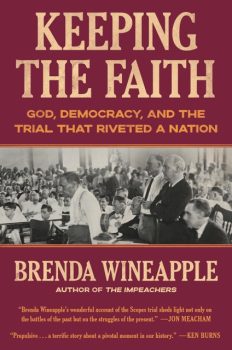 Acclaimed historian Brenda Wineapple marks the trial’s centenary in Keeping the Faith: God, Democracy, and the Trial that Riveted a Nation (Random House), a sobering investigation of how history repeats itself and how little we learn from the past. “America was a secular country founded on the freedom to worship, or, for that matter, not to worship,” she writes. This, however, did not deter the state of Tennessee from introducing the Butler Act in 1925, prohibiting the teaching of any theory that dismissed God’s creation of Adam and Eve and claimed mankind “has descended from a lower order of animals.”
The American Civil Liberties Union challenged the law within months, with the prosecution of teacher John Thomas Scopes providing the case needed to test the promotion of The Bible’s teachings at the expense of science and free speech. Prohibition had been the law of the land for five years; would restrictions similar to those imposed on the sale of alcohol be allowed to censor what schoolchildren could be taught? The stakes were high and two of the intellectual heavy-hitters of the era squared off in the courtroom. Legendary civil rights lawyer Clarence Darrow, fresh from saving Chicago thrill-killers Leopold and Loeb from execution, led Scopes’s defence. The fires of “religious bigotry and hate,” he thundered, “are being lighted today in America.” His adversary was the equally legendary William Jennings Bryan, a three-time Democratic candidate for the presidency, a fiery orator, and a devout Christian. “He believed in salvation by faith and reform by democratic action,” notes Wineapple, “through legislation that would thwart the temptations of drink and war and godless science.”
Wineapple, author of The Impeachers, a 2019 study of the impeachment of President Andrew Johnson in the wake of the Civil War, recreates the drama—as well as the silliness of this epic battle of wits. She deftly places the trial in its historical, social, and political context and captures the outsized personalities of Darrow and Bryan. A circus-like atmosphere engulfed Dayton. Preachers delivered sermons on the courthouse lawn, chimpanzees were put on display, and railroad staff told passengers they had arrived in “Monkeyville.” Hundreds of journalists descended on the town to document the confrontation between open minds and narrowmindedness. “This is twentieth-century America?” asked one incredulous reporter.
Wineapple concludes this top-shelf work of engaging history with a warning from Darrow that’s as urgent and ominous now as it was in 1925: “The powers of reaction and despotism never sleep,” the great advocate cautioned, “and in these days when conservatism is in the saddle, we have to be very watchful.”
 Anyone who has seen the musical Chicago on stage or screen—and who hasn’t?—knows how easy it was for an attractive woman to get away with murder in 1920s Chicago. A slick defense lawyer, plus a jury of twelve men willing to ignore the evidence and put chivalry ahead of duty, made an acquittal a foregone conclusion. Or did it? Charles H. Cosgrove, a retired Chicago-area university professor, proves there was more to the real story that inspired the musical in They Both Reached for the Gun: Beulah Annan, Maurine Watkins, and the Trial That Became Chicago (Southern Illinois University Press).
The musical is based on a play written by Watkins, a Chicago Tribune reporter, who drew the beauty-conquers-justice plot from Annan’s 1924 trial for murder. Annan, a bob-haired flapper in her mid-twenties, shot her lover, Harry Kalsted, in her apartment while her unsuspecting husband was at work. Tried for murder, she walked free, inspiring the main character in the play and musical, the damsel-in-distress Roxie Hart. Was justice done, in both fiction and in the real-life courtroom? Cosgrove, whose sideline as a jazz trombonist drew him to this Jazz Age story of sensational crime and questionable justice, decided to investigate. “I began to wonder,” he writes, “about the degree to which the play reflected fact, as Watkins herself more than once asserted it did.”
Fiction, it turns out, can be stranger than truth. Annan claimed she acted in self-defense, grabbing her husband’s revolver before Kalsted could reach for it during a drunken argument. Police and prosecutors, however, were convinced she killed him in cold blood, incensed that Kalsted was breaking off their affair. A purported confession further muddied the waters. Cosgrove’s deep research unearthed a smoking gun, so to speak. In a statement Annan gave soon after her arrest, she said Kalsted tried to attack and rape her and she fired only after he refused to back off. In other words, her plea of self-defense may not have been an invention designed to get her off the hook, as the prosecution claimed. Cosgrove shows how an overzealous state’s attorney massaged her words to make the shooting look like murder.
The author tracked down Kentucky-born Annan’s descendants and discovered fresh details of what he terms her “sad life history” before the shooting. She was raised by a single mother, married and a mother herself at fifteen, divorced at seventeen, remarried to Albert Annan, an automobile mechanic, at twenty. The couple settled in Chicago, where Beulah shuffled between dead-end jobs and drank too much. The Annan’s marriage was on the rocks when she began her fling with Kalsted, one of her co-workers, and the stage was set for the shooting.
Cosgrove shows how Watkins and other reporters embellished quotations and stretched the truth (a common practice for the Jazz Age press) to inject drama and pathos into Annan’s story. News reports asserting she was “glad” she had shot Kalsted were among the fabrications he discovered. Watkins’s portrayal of her as a woman who disposed of an unwanted lover—and got away with murder, thanks to a sympathetic jury—became the accepted narrative, a distorted image of 1920s Chicago justice that Broadway and Hollywood have presented to millions. The real rot in the city’s administration of justice crooked cops, corrupt politicians and judges, prosecutors with underworld ties—escaped exposure. But Annan’s case, Cosgrove discovered, was an outlier. Few women were prosecuted for murder during the decade and the rate of acquittals turns out to have been about the same as for male defendants. Cosgrove’s absorbing book reads like a police procedural as the author gathers and dissects evidence, reclaims Annan’s story, and corrects a century of misconceptions.
Joan Barry was twenty-one years old and desperate to become a movie star. He was a legendary comic actor and director in his fifties and one of the biggest names in Hollywood. Barry met Charlie Chaplin in 1941 and soon became his latest leading lady—on screen and off. Their volatile relationship became the focus of an FBI investigation, landed Chaplin in court on charges of sex-trafficking and conspiring to improperly influence a judge, triggered a scandalous paternity suit, and ultimately led to the movie mogul’s banishment from the U.S.
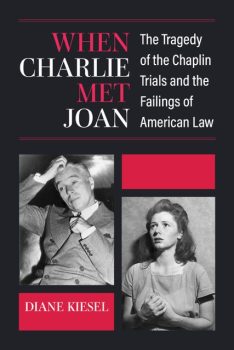 Diane Kiesel, a retired judge of the New York Supreme Court, revisits this mid-twentieth century #MeToo moment in When Charlie Met Joan: The Tragedy of the Chaplin Trials and the Failings of American Law (University of Michigan Press). “The story of the Charlie Chaplin-Joan Barry trials is an entertaining yarn about Old Hollywood,” she notes, and turns a spotlight on “serious issues about the power of celebrity, Cold War politics, the media frenzy surrounding high-profile court proceedings, and the sorry history of the Hollywood casting couch.”
Kiesel’s insightful, brisk narrative portrays Chaplin as a movie visionary whose unhealthy attraction to young women was his downfall. “He’s an artist,” a colleague explained, “he has no common sense.” Chaplin claimed to have slept with 2,000 women and married all three of his wives while they were teenagers, the last when she was barely eighteen and he was fifty four. One lawyer condemned him as a “lecherous hound” and “a master mechanic in the arts of seduction” who “goes around fornicating . . . with the same aplomb that the average man orders bacon and eggs for breakfast.”
Chaplin met Barry in 1941 and their brief, troubled relationship was disastrous for them both. Barry, unstable and suicidal, stalked Chaplin and claimed he had fathered her child. Chaplin’s bid to ship her out of California and away from the Hollywood press backfired when he was charged with violating the Mann Act. It was a federal offense to transport a woman across state lines for immoral purposes, a decades-old law designed to combat white slavery, and Chaplin had paid for Barry’s tickets to travel between New York and L.A.
Chaplin was acquitted but, after a follow-up civil trial, was ordered to pay support even though a blood test proved he was not the father of Barry’s child. A greater injustice followed in 1952, when he was refused entry to the U.S. after a trip abroad, based on the Barry sex scandal and his public support for Russia when the Soviets were U.S. allies during World War Two, which was not a good look in the McCarthy era. Chaplin lived in exile in Switzerland, returning briefly in 1972 when he was granted permission to attend the Academy Awards ceremony and accept an Oscar for lifetime achievement.
Kiesel’s book is a cautionary tale about the abuse of power by individuals and institutions. Chaplin used his movie-industry clout to seduce wannabe actresses he promised to turn into stars; the U.S. government discredited the British-born, left-leaning, scandal-prone movie titan and barred him from the country he had called home for almost four decades.
————-
Dean Jobb’s latest true crime book, A Gentleman and a Thief: The Daring Jewel Heists of a Jazz Age Rogue (Algonquin Books and HarperCollins Canada), is a New York Times Editors’ Choice and a national bestseller in Canada. It’s the story of Arthur Barry, who charmed the elite of 1920s New York City while planning and executing some of the most brazen jewel thefts in history. Find him at deanjobb.com.
Copyright © 2025 Dean Jobb