
Stranger Than Fiction
May 2025
One Murder, Two Activists, and the Birth of the New York State Police
by Dean Jobb
It was a Wild West-style ambush. As a motorcycle zipped along an isolated stretch of road near the village of Mount Kisco, about forty miles north of New York City, four men armed with pistols emerged from the brush and stood in its path. The driver, Samuel Howell, a supervisor for a building contractor in the city, was headed to the firm’s construction sites with the week’s payroll on a summer’s afternoon in 1913. He ignored the men’s shouts for him to stop and hit the gas. They opened fire as he sped past. At least two bullets hit him, but Howell kept driving. He made it to a house about a half mile away before he collapsed in the yard.

A New York Central Railroad car was requisitioned to whisk him to a hospital in the city. Howell identified two of his assailants—Italian laborers his firm had recently fired from one of its building sites. Surgeons operated, but the bullets had pierced his intestines and the twenty-eight-year-old died two days later. The New York dailies, with plenty of murders, assaults, and robberies to cover on their home turf, took little notice of the brazen attack in rural Westchester County. “Shot By Bandits, Saves Payroll By Motorcycle Spurt,” announced a headline in the Evening World, one of the few city papers to report on the crime. The New York Times relegated the murder to a single paragraph buried on page 14. Two Westchester County residents, Katherine Mayo and Moyca Newell, were incensed. “A clearer case of identification, an easier case to handle,” claimed Mayo, “will never occur in the history of crime.” Howell’s assailants had holed up in a wooded area near the scene of the shooting, waiting for nightfall, but the county sheriff and the local constable refused to confront them or to organize a posse—and they escaped. “In the great rural State of New York, protection of life and property is a private luxury to be obtained only by those rich enough to pay for it,” Mayo fumed. Farmers, working men, “the woman alone on an isolated homestead”—all were as “easy prey to criminal attack as if they moved in the wilds of Mexico.”
Mayo, who had grown up in a wealthy Pennsylvania family and was making a name for herself as an author and activist, and Newell, her lifelong friend, were among the privileged few who could afford to hire private security guards and install burglar-alarm systems.

Newell was a multimillionaire in her mid thirties, having inherited $3.5 million—equivalent to about $110 million today—from her family’s business and real-estate empire in Kenosha, Wisconsin. Generous and civic-minded, she was a leader in the suffragette movement, had campaigned to put Woodrow Wilson in the White House in 1912, and devoted her time and money to a variety of charities and community initiatives. Howell’s murder gave her a new cause to champion. Newell was building a mansion in Mount Kisco and she appears to have known the victim, whose firm was the contractor for the project.
Mayo, too, had a personal connection to Howell’s death. “I spent the entire day of the murder on the spot,” she recalled, and witnessed “the complete breakdown” of local law enforcement. “It was impossible to remain inactive—to remain an idle conniver in the toleration of such a disgrace.” New York needed a statewide police force to protect rural communities, filling the law-enforcement vacuum that existed outside its cities and towns. Mayo and Newell were determined to give it one.
In the early 1900s, law enforcement in rural America was a throwback to the Middle Ages. “The countryside for the most part still turns for protection against marauders to the constable and the sheriff’s posse,” notes a history of policing from that era. “There is little to distinguish them from the keepers of the King’s law in Merrie England of the Thirteenth Century.”
* * *
This time-tested model worked until the railroad and the automobile made it easy for city dwellers to tour the countryside. Armed robbers, burglars, and safe-crackers came in their wake, lured to remote areas where the chances of getting caught—as Howell’s killers had proven—were slim. The nouveau riche and well-heeled of the Gilded Age, like Newell, were building mansions and summer homes in the Hudson River Valley that offered fresh incentives for New York crooks to venture into Westchester County.
Newell and Mayo built a case for the creation of a state police force. There were only a few precedents—the Royal Canadian Mounted Police, established in 1873 to police Canada’s western frontier; the Texas Rangers, who patrolled the border with Mexico; and the Pennsylvania State Police, formed in 1905 in response to the state’s strike-prone mining and steelmaking areas. The women studied the Pennsylvania model and encouraged New York to follow its neighbor’s lead. Mayo eventually published a history of the force and enlisted Theodore Roosevelt, who modernized the New York Police Department before becoming president, to write the introduction.
A committee organized to lobby for the creation of a state force for New York faced powerful opponents. The Republican governor, Charles Whitman, was on-side, and that was enough to convince state Democrats to vote against the idea. Unions were also hostile, fearing the new officers would be deployed to quell strikes and labor protests. And some in the rural areas the new force would patrol
were not convinced that hiring policemen was a good use of their tax dollars. The “Department of State Police,” as it was officially known, was finally created in 1917, with a half-million-dollar budget, just as the United States entered World War One. A training center set up in Manlius, New York was christened Camp Newayo, a mash-up of the names Newell and Mayo.
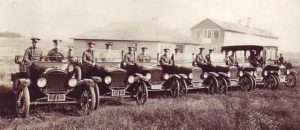
The initial roster of 230 officers was responsible for patrolling 45,000 square miles of the state—an area “the size of a Balkan kingdom,” as one writer put it. They patrolled on horseback at first, and their grey uniforms earned them the nickname the Grey Riders. The officers were soon known as State Troopers. When Democrat Al Smith defeated Whitman and became governor in 1919, he threatened to disband the force. But the Troopers quickly proved themselves to be an efficient force. By 1920, officers were rounding up twice as many suspects as their NYPD counterparts and almost all of those arrested were ultimately convicted of their crimes. “For stark efficiency,” boasted the author of an early history of the force, “the record of the grey riders in 1920 has never been equalled in the history of rural police of this continent.”
West Virginia followed the lead of Pennsylvania and New York and established a force in 1919. Today, 49 states have some form of statewide law enforcement agency, from forces like New York’s that investigate all crimes to highway patrols that focus on traffic safety and infractions of motor-vehicle laws. The exception is Hawaii, where the major islands each have a police force.
New York’s force grew rapidly. Ford Model Ts and motorcycles quickly replaced mounted patrols. The force was called in to quell two major inmate riots at Auburn’s state prison in 1929. Boat and airplane patrols and a dive unit were added in the 1930s, and a plainclothes detective branch was created in 1935. Today the force numbers more than 5,000 officers, with a mandate that emphasizes highway safety, criminal investigations, disaster relief, and counterterrorism measures.
* * *
Samuel Howell’s murder remains unsolved. An Italian man named Giuseppe Serranpi was arrested in Mount Kisco soon after the murder but was never charged. Another suspect, Charles Nadeo, described in the press as the leader of one of the notorious Black Hand blackmailing gangs that terrorized Italian communities, was picked up in Ohio in 1915. The New-York Tribune reported that he confessed to shooting Howell, but his claim to have stolen a $5,000 payroll casts doubt over his admissions; news coverage at the time of the shooting confirmed that Howell was carrying only $1,700 and still had the money when rescuers came to his aid. Nadeo, like Serranpi, was never prosecuted. Mayo and Newell continued their activism in Mount Kisco and beyond. Newell supported the Red Cross and served as a nurse in France during the war. In the 1920s, she founded a New York-based organization that helped young sailors train for service in the British merchant marine, an initiative that earned her the honor of being named a commander of the Order of the British Empire. Mayo continued to write and published a book praising the Young Men’s Christian Association’s charitable work overseas during the war. She toured India with Newell and in 1927 published Mother India, a book condemning the practice of child marriage. The book became an international sensation, earning praise in Britain’s House of Commons and sparking outrage in India, where copies were burned in protest.
Mayo died in 1940 at age seventy-three, leaving behind an unfinished book about the international drug trade. A contingent of twenty-five state troopers attended her funeral in recognition of her role in creating the force.
In 1967, Newell took part in a celebration of the fiftieth anniversary of the founding of the State Police and referred to the officers as “my children.” When she died the following year, at eighty-six, headlines proclaimed her the “mother” of the force. The efforts of Newell and Mayo, noted one news report of her death, had ensured that rural areas of New York State enjoyed “the same police protection . . . that was afforded city dwellers.”
Ironically, in 1925, Newell needed the help of the police force she had worked so
hard to establish. That December William Ferguson, a twenty-year-old man serving time for theft, broke out of the Westchester County jail and stole a car from a garage on the sprawling estate of Standard Oil founder John D. Rockefeller, near Tarrytown. He then drove to Newell’s home on Guard Hill Road in Mount Kisco, where he had once worked. No one was home when he broke in, grabbed some jewelry, and exchanged his prison uniform for men’s clothing he found in the house. Ferguson seems to have suspected that state troopers would work overtime to catch someone who burgled the home of their “mother” and stole from one of the world’s richest men. He fled across the Connecticut state line and disappeared.
————-
Dean Jobb’s latest true crime book, A Gentleman and a Thief: The Daring Jewel Heists of a Jazz Age Rogue (Algonquin Books and HarperCollins Canada), is a New York Times Editors’ Choice and a national bestseller in Canada. It’s the story of Arthur Barry, who charmed the elite of 1920s New York City while planning and executing some of the most brazen jewel thefts in history. Find him at deanjobb.com.
Copyright © 2025 Dean Jobb