
Stranger Than Fiction
October 2025
Doing the Crime
by Dean Jobb
From devious letter bombs and well-honed axes to the vitriol of poison-pen letters, recent true crime books turn a spotlight on three weapons in the criminal’s arsenal.
The year was 1712 and Jonathan Swift, the Anglo-Irish satirist and political activist who would become famous as the author of Gulliver’s Travels, was visiting Robert Harley, the Earl of Oxford, in London. Harley, the Lord High Treasurer, was Queen Anne’s chief minister—a post that would soon become known as prime minister—and had survived an assassination attempt the year before. That may have been why Swift was suspicious about a hatbox that had been delivered to the most powerful man in England.
Swift examined the package and spotted threads hanging from the lid. He snipped the threads before opening the box and discovered loaded pistols inside. The threads had been attached to the triggers and could have fired the weapons when the box was opened, potentially wounding or killing Harley. It’s the first recorded use of an explosive device disguised as a delivery or a piece of mail, and undoubtedly the first time a writer of satire managed to detect and defuse a letter bomb.
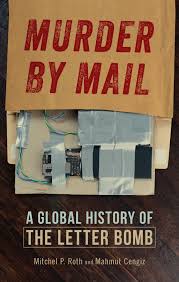 Swift’s quick thinking is one of the many stories of mayhem and death recounted in Murder by Mail: A Global History of the Letter Bomb (Reaktion Books). It’s billed as “the first comprehensive and scholarly history of parcel, package and letter bombs,” and authors Mitchel P. Roth and Mahmut Cengiz have scoured three centuries of lethal deliveries to discern methods, patterns, and motives. One terrorism expert has described mail bombs as “one of the meanest and most cowardly of all forms of attack.” While addressed to a specific target, their aim is seldom true—most kill or maim the postal workers handling them or the receptionists and secretaries who open the boss’s mail.
Roth, a professor of criminology, and Cengiz, a terrorism and global crime expert, explore the increasing sophistication of mail bombs, their proliferation around the globe, and why they were sent. Ted Kaczynski, the Unabomber, is the best-known mail bomber. His eighteen-year campaign—designed to promote his distrust of technology—killed three people and injured two dozen more before his arrest in 1996. As the authors show, many others have launched bombing campaigns for political ends, from anarchists and suffragettes to lone-wolf extremists. Cesar Sayoc, Jr., a former male stripper, became known as the MAGAbomber after he dispatched bombs in 2018 to the Clintons and other Democrats opposed to Donald Trump.
For most letter bombers, however, the attacks are personal and the targets are former employers or ex-spouses; blackmail and mental illness are also common motives. “Along with poisoners, mail bombers are distinct from other criminals;” the authors argue. “They plan meticulously, nurse long grudges and retaliate far out of proportion to any injury they feel they might have received.” The sheer number of mail-bombers who have plied their death-at-a-distance trade is shocking, and readers will be heartened to discover how many have been thwarted by diligent postal workers and caught thanks to painstaking police and forensic investigations. Despite the ingenuity of bombers and the sophistication of their devices, old-fashioned sleuthing by Jonathan Swift’s bomb-detecting successors—such as tracing fragments of newspaper and other materials used to pack explosives for shipping—has put many behind bars.
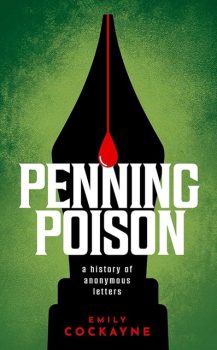 Anonymous mail can deliver messages far less lethal than a bomb, yet in some ways almost as upsetting and disruptive to the recipients—everything from blackmail demands and death threats to gossip, abusive comments, and allegations of wrongdoing or immoral behavior. Emily Cockayne, a history professor at the University of East Anglia, has undertaken the daunting task of tracking down almost two centuries’ worth of poison-pen letters sent to people from all walks of life in Britian. Penning Poison: A History of Anonymous Letters (Oxford University Press) analyzes letters someone felt compelled to write and deliver “with the aim, or apparent aim, of unsettling the person they were sent to.”
Her task was daunting because people are more likely to destroy an abusive message than to keep it. “This is probably why they have been little studied by historians,” Cockayne writes. Letters were burned or trashed out of shame or embarrassment; they either revealed a secret or the target feared others might believe the lies they contained. A “venomous” and “wildly malignant” letter sent to Nella Last in 1940 has not survived but the London woman noted, in her diary, her revulsion when she read it.
Faced with a challenge of tracking down and assembling such elusive letters, Cockayne put her formidable scholarly detective skills to work. She scoured newspapers and archival records to find out who received poison pen letters and who sent them and why. The famous and unknown alike were on the receiving end; the senders were seeking to avenge a wrong—real or perceived—or to strike back at an enemy—again, real or perceived. Most senders, not surprisingly, were nasty people who wanted to frighten or upset their targets; others were mentally ill.
The author devotes chapters to the specific content of letters—gossip, threats, obscenities and the like. Walter Frederic Mason, an engineer and factory owner in Ipswich, was behind one of the many one-offs and letter-writing campaigns Cockayne investigates. Mason sent “revolting and disgusting” letters to women and girls—one as young as twelve—before he was caught and imprisoned in 1877. He proved easy to catch. His letters were postmarked at the same place and at about the same time of day, and the police simply staked out the post office until he turned up carrying a fresh batch of missives. Most senders were much harder to identify. Handwriting analysis, an inexact science in Victorian times, betrayed some of them, forcing poison-pen aficionados to try to disguise their handwriting, type their letters, or create ransom note-style text clipped from publications. The police were also the recipients of letters and postcards containing anonymous tips about suspects and crimes, some true but most not. Jack the Ripper got his name from the signature on a letter sent to a news agency at the height of the Whitechapel serial murders in 1888. The writer claimed to be the killer but the note is considered a hoax.
Cockayne’s investigation focuses on letters written and delivered between the 1760s and the start of World War Two. She chose the end point to avoid opening old wounds or re-victimizing recipients or relatives who are still alive. “This is a subject that involves secrets, slanders, and intrusions upon intimate space,” she explains. Besides, the internet has changed everything, flooding the public sphere with anonymous comments and attacks—an investigation that included today’s virtual poison-pen letters and the trolls posting them demands its own volume. The author’s restraint and sensitivity, however, demonstrates the power of anonymous letters to harm and unsettle long after they have been opened and read.
 “Lizzy Borden took an axe/And gave her mother forty whacks. . . .” It would be tough to find someone who hasn’t heard this grisly schoolyard rhyme, or is unaware that the most infamous resident of Fall River, Massachusetts proceeded to inflict another forty-one whacks on her father. The double homicide at the Borden home in 1892 is one of the most notorious axe murders in history and a shoo-in for full-chapter treatment in Whack Job: A History of Axe Murder (St. Martin’s Press) by Rachel McCarthy James.
“Axes are at their core utterly common,” she writes, “as ubiquitous as weapons as they have been as tools. They are everywhere in our story of violence, so much a part of the texture of our conflicts that they become banal, unworthy of note.” Axes for felling trees and chopping firewood once were found in almost every rural and small-town household—there were no fewer than five in the basement of the Borden home when the couple was murdered.
This book is about much more than murders committed with the humble axe. McCarthy James digs into the historical record to trace humans’ development, use, and murderous abuse of a tool that was perfect for warfare and for executions by beheading. Our ancestors were using teardrop-shaped flint axes millions of years ago to butcher game, and it was only a matter of time before early humanoids began using them on each other. A cracked skull scientists have designated Cranium 17, unearthed in Spain and more than 400,000 years old, appears to be the first-known victim of an axe murder. The eventual addition of a wooden handle and a metal blade made the axe more useful and more lethal.
Whack Job—could there be a more perfect title for a book on the axe as a murder weapon?—is a breezy read that sweeps through history. McCarthy James stops here and there for a closer look at axes and hatchets developed for specific uses, from roofing repairs to shipbuilding, and how they came in handy for murder. She writes in a style that alternates between chatty and serious—I doubt the words “pissed off” and “suzerainty” have appeared before in the same paragraph. There are pop culture touchstones, from the axe as a prized weapon in video games to the actor Jack Nicholson using a fire axe to break down a door in the movie The Shining. And plenty of trivia: Who knew that one of the Egyptian hieroglyphs for the word “enemy” is a man with an axe embedded in his head?
McCarthy James knows her stuff. She co-wrote, with her father Bill James, the 2017 book The Man from the Train, which claimed that a single serial killer, a laborer named Paul Mueller, may have been responsible for as many as 100 axe murders across North America between 1898 and 1912. The book documented similarities in the crimes and theorized that he likely caught trains to travel between far-flung crime scenes. If he was responsible for even a fraction of these killings, Mueller was an axe-murder professional. Most of the murders showcased here, in contrast, were committed spur-of-the-moment and an axe was the weapon closest at hand. Was this the case with the Borden murders, or was the killer a stranger who brought an axe to their house with murder in mind? The answer, of course, will never be known for certain. Lizzie Borden may have been convicted of whacking them in rhyme, but a jury acquitted her in court.
————-
Dean Jobb’s latest true crime book, A Gentleman and a Thief: The Daring Jewel Heists of a Jazz Age Rogue (Algonquin Books and HarperCollins Canada), is a New York Times Editors’ Choice and a national bestseller in Canada. It’s the story of Arthur Barry, who charmed the elite of 1920s New York City while planning and executing some of the most brazen jewel thefts in history. Find him at deanjobb.com.
Copyright © 2025 Dean Jobb